Food For all: understanding food insecurity & community food access
Food insecurity, emergency food support and community food access are connected, but they are not interchangeable. Household food insecurity is fundamentally an income issue and requires policy solutions that improve household financial security. At the same time, communities have an important role to play in creating affordable, accessible and dignified ways for people to access food. Strong emergency food supports help people through crises; upstream community food initiatives can help strengthen access, choice and resilience; and income-focused policy addresses the root causes. We need all three, working together.
Are you a 2026 candidate running for a councillor, mayoral, County ward or trustee position representing all or part of the Township of Centre Wellington?
Join us for Come to the Table: A Candidate Open House on Household Food Insecurity & Community Food Access. Learn More & Register
-
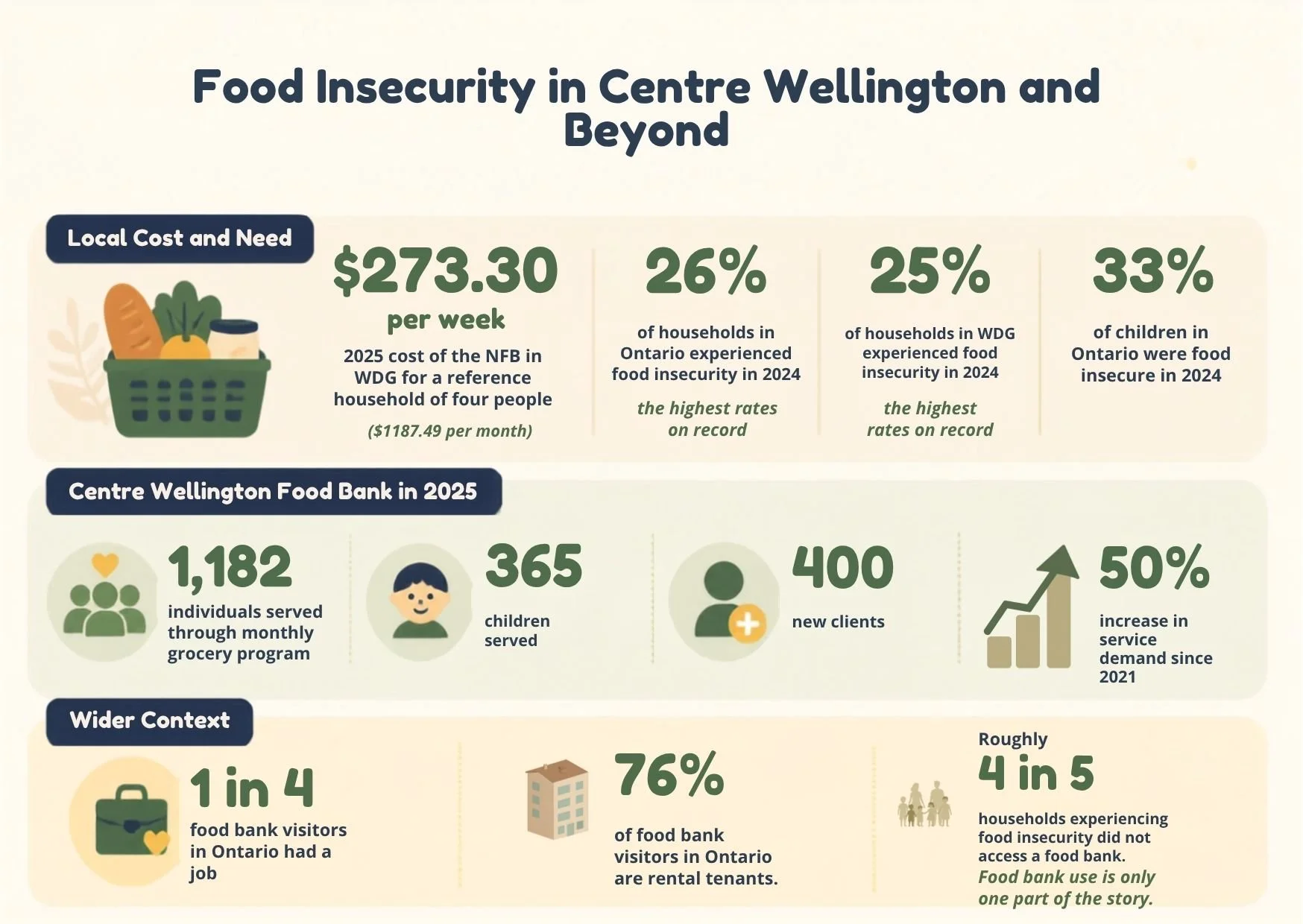
Household food insecurity means inadequate or insecure access to food because of financial constraints and exists on a spectrum from mild to severe. Food is where we see the problem, but inadequate income, unaffordable housing, insufficient social supports and rising costs are often where it begins. More food alone cannot solve household food insecurity.
-
Food banks provide an essential safety net, and demand continues to grow. Increasingly, people arrive after stretching their resources, making difficult trade-offs and holding on for as long as they can. We need to respond to the crisis while addressing the conditions driving it.
-
Community food access is also shaped by geography, transportation, affordability, grocery availability, culture and stigma. This is particularly important in rural communities, where having money for food does not necessarily mean having a reasonable way to access it. Where, when and how people access food matters.
-
Many households are stretching groceries, compromising choices, giving up other necessities or living one unexpected expense away from crisis. Affordable, accessible community food initiatives can help people stretch their resources while maintaining choice and dignity. They don't replace adequate income or emergency food support; they strengthen the space in between.
-
Food access is about more than having enough to eat. Dignified, affordable and welcoming food spaces support health, choice, connection, belonging and resilience. A stronger community food system responds to crises while investing upstream in the conditions that help people remain well.
The numbers